
Thursday September 17
NICK HAKIM
ARIMA EDERRA
Doors at 7:30

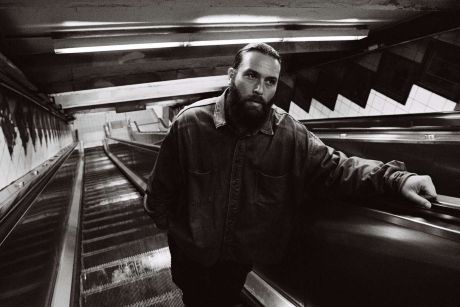
Nick Hakim sits somewhere between an analytical philosopher, mystic poet, and abstract painter. To hear him speak of music is to encounter someone who fully understands its power, who has been moved by its magic and seen its miracles. He’s devoted to music as both an ancient artform and eternal medicine. To hear him play music is to feel these truisms in live time. It’s a spirit that the New York-based songwriter has carried in his music—both as composer and collaborator. From early LPs like 2017’s Green Twins and 2020’s Will This Make Me Good, to his new album, I Can See, Hakim has pursued the truth in every note he’s written, every lyric he’s sung. His truth, though, is more akin to the abstract and intangible than the factual—more Borges than George Washington. It's a cosmic assuredness that manifests throughout I Can See; a belief that the good in the universe is good for a reason.
There’s a song on I Can See that offers insight into the way Hakim wrote, imagined, and recorded the album. “Real Here Now” tells the story of a house. It’s a house not dissimilar from the one Hakim grew up in, but in this domicile, he can interact with family members who have since left this realm. It’s a lo-fi subdued soul-pop jam and features some of Hakim’s most direct lyricism to date: “Haven’t seen you in a minute, I’m good,” he begins. In describing the composition, Hakim refers to the “feeling of a song,” how he wanted “Real Here Now” to exist as a nostalgic reminder of the feeling he has when imagining this space; a place in which those who have left find their voices again. “It’s connected to hearing someone sing songs you used to always hear. Now, you just a have a memory of them.” How sweet it would be to hear them just one more time, Hakim expresses on the song.
Like almost all of I Can See, “Real Here Now” was recorded during the same time as Hakim’s last LP, 2022’s Cometa, but it exists in an entirely different universe than the one in which that project rests. It also, to a certain extent, exists in a different world than some of I Can See. Half of the album was recorded at Sonic Ranch in Texas, and the other half was pieced together in Hakim’s New York apartment. Both sessions took place during the pandemic, and as such, I Can See is a living, breathing reaction to Hakim’s shifting space in the world. It’s an image of an artist coming to terms with their reality, captured in such a way that it reveals new angles with
each subsequent viewing—or, in our case, each subsequent listen.


Take Metro! Black Cat is located just three blocks from the U Street/Cardozo Metro Station.
Website designed by Alec Bourgeois, illustration by Lucio Schiavon © 2010 Circle I Productions